
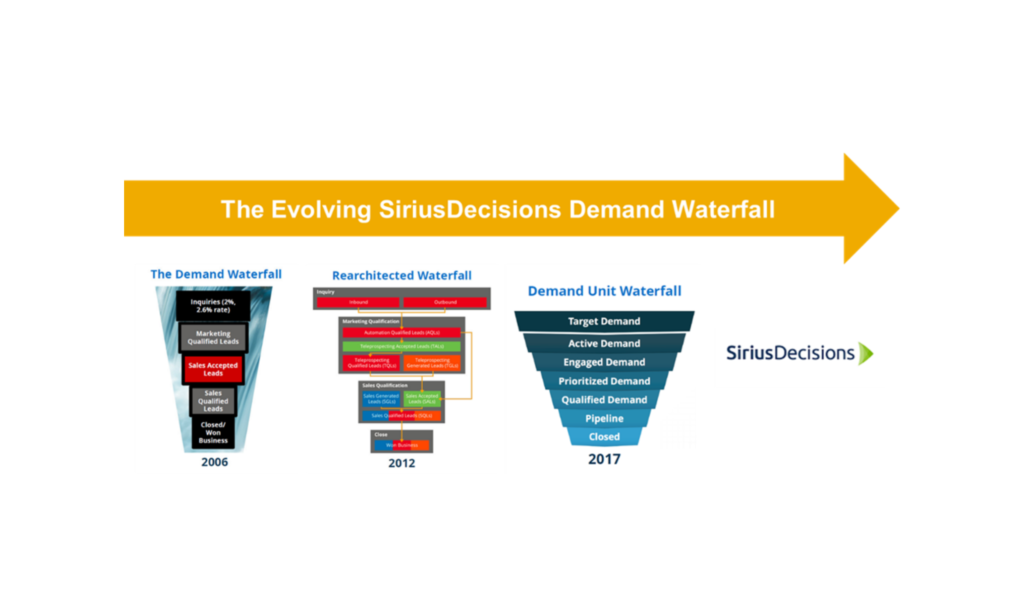
SiriusDecisions were a sales oriented consultancy with little understanding of the role of marketing in general, and especially that role outside of high growth tech businesses.
The first major revision, the 2012 ‘Rearchitected Waterfall’, was built around this assumption that the whole reason for marketing (and junior sales) existing is purely for lead generation and filling the funnel. This aligned with SiriusDecisions’ wider thinking, which did indeed see marketing as all about lead generation, and while this is a major role of marketing and helps with top line revenue growth, there are more subtle requirements of marketing too. Innovation, Customer stickiness and satisfaction, are just three of these. In fact, at an early Sirius conference they were advocating web to CRM as a fundamental integration, not realising technologies such as Marketing Automation even existed. So naturally their views of the role of marketing were a little limited too.
There is also the issue that there are on average 5 people in a decision-making unit, each with their own needs and requisite experiences, ultimately requiring a sophisticated set of varied customer journeys. Marketing and Sales are very rarely – if at all – selling to just one person in an organisation, and this model didn’t reflect that.
The 2012 model was static, built around set stages and simple but standard definitions. MQL’s, SAL’s (and all the other three-letter acronyms) are only really suited to high growth lead generation environments, ones again where the entire Marketing and Sales departments revolve solely around lead generation, much like Sirius themselves. However, most businesses are more transactional and so this subtler model is needed. Sales and Marketing alignment was also difficult under this methodology simply because they weren’t speaking the same language, and the number of acronyms verged on the unnecessary.